
What Are Crystals? A Beautiful Introduction to Earth’s Natural Treasures
Crystals have a way of making us pause.
Perhaps it is the way they catch the light, the precision of their natural shapes or the astonishing colors that seem almost too beautiful to have formed without human hands. Some emerge as delicate points. Others grow into immense cathedrals, glittering geodes or sculptural formations unlike anything else on Earth.
Yet before a crystal becomes a treasured object in a home, it begins somewhere far beneath the surface—as part of a remarkable natural process that can take thousands, millions or even billions of years.
So, what exactly is a crystal?
A Work of Nature Built Atom by Atom
A crystal is a solid material whose atoms, molecules or ions are arranged in an orderly, repeating pattern. This internal structure is known as a crystal lattice.
Think of it as nature building with extraordinary precision. The particles repeat in an organized design too small for us to see, but that hidden arrangement can influence the crystal’s visible shape, symmetry and the angles at which its faces meet.
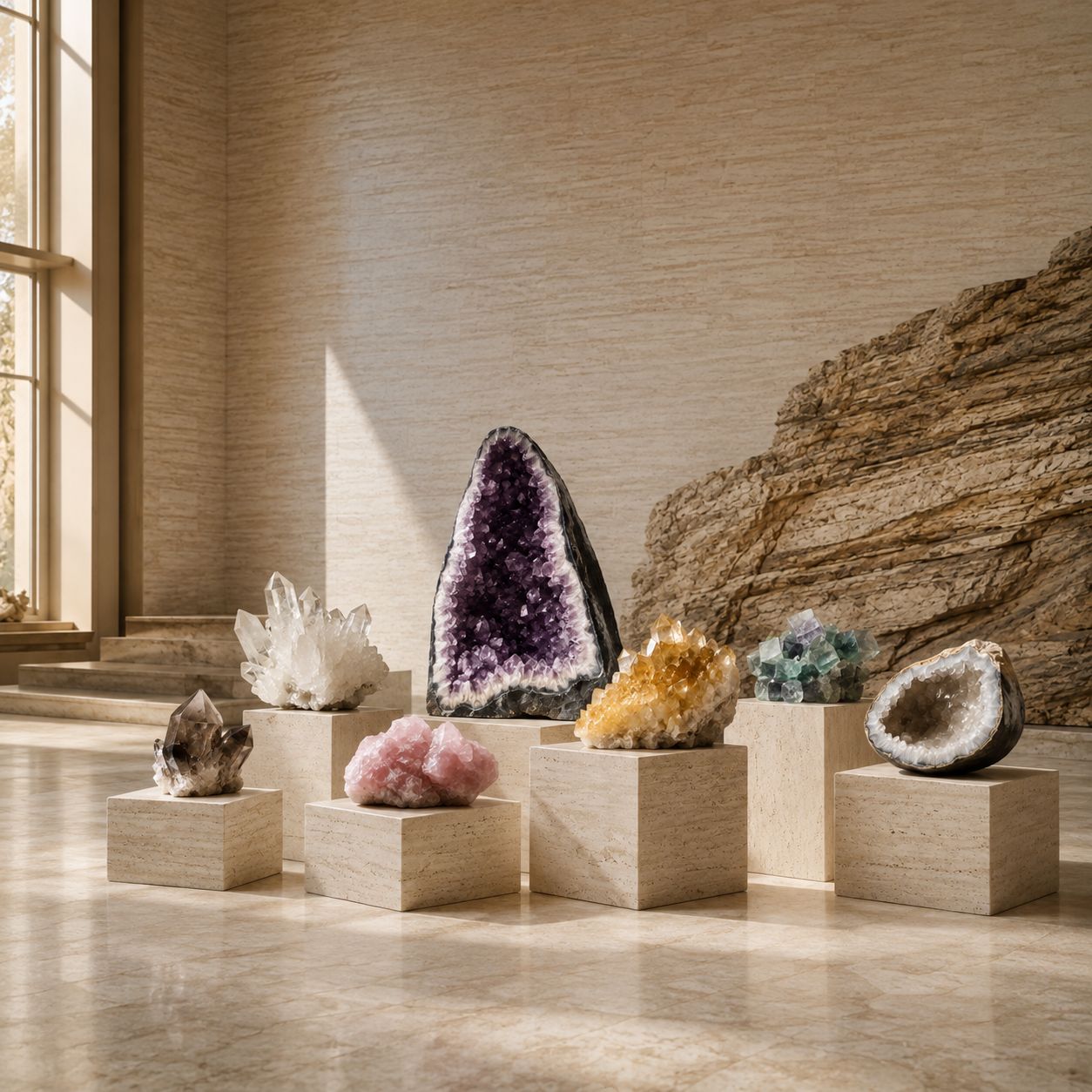
Quartz, for example, often grows with six-sided prisms that end in pointed faces. Halite—commonly known as rock salt—frequently forms cubes. Fluorite may appear as cubes or octahedrons. These shapes are not carved into the stone; when conditions allow crystals to grow freely, they are expressions of the material’s internal structure.
What looks like nature’s decoration is actually nature’s architecture.
How Do Crystals Form?
Crystals can form in several ways, but each process requires the right materials, temperature, pressure, space and time.
Some crystals form as molten rock cools. As magma below Earth’s surface or lava above it gradually loses heat, atoms begin to arrange themselves into ordered structures. When cooling happens slowly, crystals may have more time to grow larger. When it happens quickly, they are usually much smaller.
Other crystals grow from mineral-rich water. As water moves through cracks and open cavities in rock, dissolved minerals can be left behind. Layer by layer, crystal growth takes place. Changes in heat, pressure and chemistry influence what forms and how it looks.
Still others develop under intense heat and pressure deep within the Earth as existing rocks and minerals are transformed.
There is no single recipe. Every specimen reflects the particular environment in which it grew.
Crystals, Minerals and Stones: What Is the Difference?
The words crystal, mineral and stone are often used interchangeably, but they do not mean exactly the same thing.
A mineral
is a naturally occurring, inorganic solid with a characteristic chemical composition and an ordered internal structure. Quartz, calcite and fluorite are minerals.
A crystal
describes a material with an orderly, repeating internal arrangement. Many minerals are crystalline, although their individual crystal shapes may not always be visible. The word can also describe a single crystal or a group of intergrown crystals.
A rock
is usually made from one or more minerals. Granite, for instance, commonly contains quartz, feldspar and mica.
A stone
is a broader everyday term. It may refer to a rock, mineral, crystal, gemstone or polished decorative material.
These categories can overlap, which is why the language sometimes feels confusing. A single beautiful object may accurately be described in several ways depending on whether we are discussing its composition, structure, appearance or use.
What Is a Geode?
A geode is a hollow or partly hollow rock lined with minerals or crystals on the inside.
It begins with a cavity—often within volcanic or sedimentary rock. Over time, mineral-rich water moves through the surrounding material and deposits layers along the cavity walls. Crystals may eventually grow inward, creating a sparkling interior hidden beneath an ordinary-looking outer shell.
Until a geode is opened, its beauty may remain entirely unseen.
Large amethyst geodes are sometimes called cathedrals because of their tall, arching forms. These extraordinary specimens can become commanding pieces of natural art, bringing color, scale and millions of years of Earth’s history into a space.
Why Does the Same Crystal Appear in Different Colors?
Color can be created by a mineral’s essential chemical ingredients, by tiny amounts of other elements, by structural defects or by natural radiation acting over long periods of time.
Quartz is one of the most familiar examples. In its pure form, it is clear or milky. Under different geological conditions, the quartz family can include purple amethyst, pink rose quartz, smoky quartz and yellow to golden citrine.
Even two specimens of the same variety will not be identical. Their color saturation, clarity, inclusions, growth patterns, points and surrounding matrix can differ dramatically.
These variations are not imperfections. They are the record of how and where each piece came into being.
Why Is Every Natural Specimen Unique?
No two natural crystals experience precisely the same conditions.
Temperature can change. Pressure can shift. The mineral solution feeding the crystal may become richer, weaker or chemically different. Growth may pause and begin again. Another mineral may appear alongside it, become enclosed within it or alter the shape in which it develops. Space within the host rock can limit or redirect growth.
The result is individuality written in stone.
One specimen may feature perfectly defined points. Another may hold delicate veils, bands of color or mineral inclusions. A towering geode may reveal an interior landscape that existed in darkness until the moment it was discovered.
This is what makes collecting natural crystals so compelling: each one is genuinely one of a kind.
Why Have People Treasured Crystals for So Long?
Across cultures and centuries, people have valued crystals and minerals for their beauty, rarity, durability and practical uses. They have been fashioned into jewelry, carved into decorative objects, included in important collections and studied as clues to the history of our planet.
Today, crystals continue to live in many worlds at once. They are studied by mineralogists and geologists. They are collected as natural history specimens. They appear in jewelry, architecture, watches, electronics and works of art. In homes, hotels and offices, exceptional pieces are increasingly displayed as sculptural focal points.
People may also attach personal, cultural or spiritual meaning to certain crystals. Those meanings belong to individual beliefs and traditions; they are different from the scientific study of what crystals are and how they form.
What unites so many admirers is wonder: the recognition that the Earth can create something astonishing without making the same thing twice.
Living With a Piece of Earth’s Story
To bring a crystal into your home is to live beside an object shaped on a timescale far greater than our own.
A crystal does not need to promise anything in order to be meaningful. Its beauty, origin and singularity are enough. It can remind us of time, transformation, patience and the extraordinary creativity present in the natural world.
At Haus of Healing, we view crystals as natural treasures and works of Earth’s art. Whether a piece is small enough to hold in your hand or large enough to define an entire room, it carries a story that began long before it reached us.
The next time a crystal catches your eye, look a little closer. Notice its color, structure, texture and the places where another mineral may have joined its growth. What you are seeing is not simply something beautiful.
You are seeing the visible record of the Earth becoming.
Read more
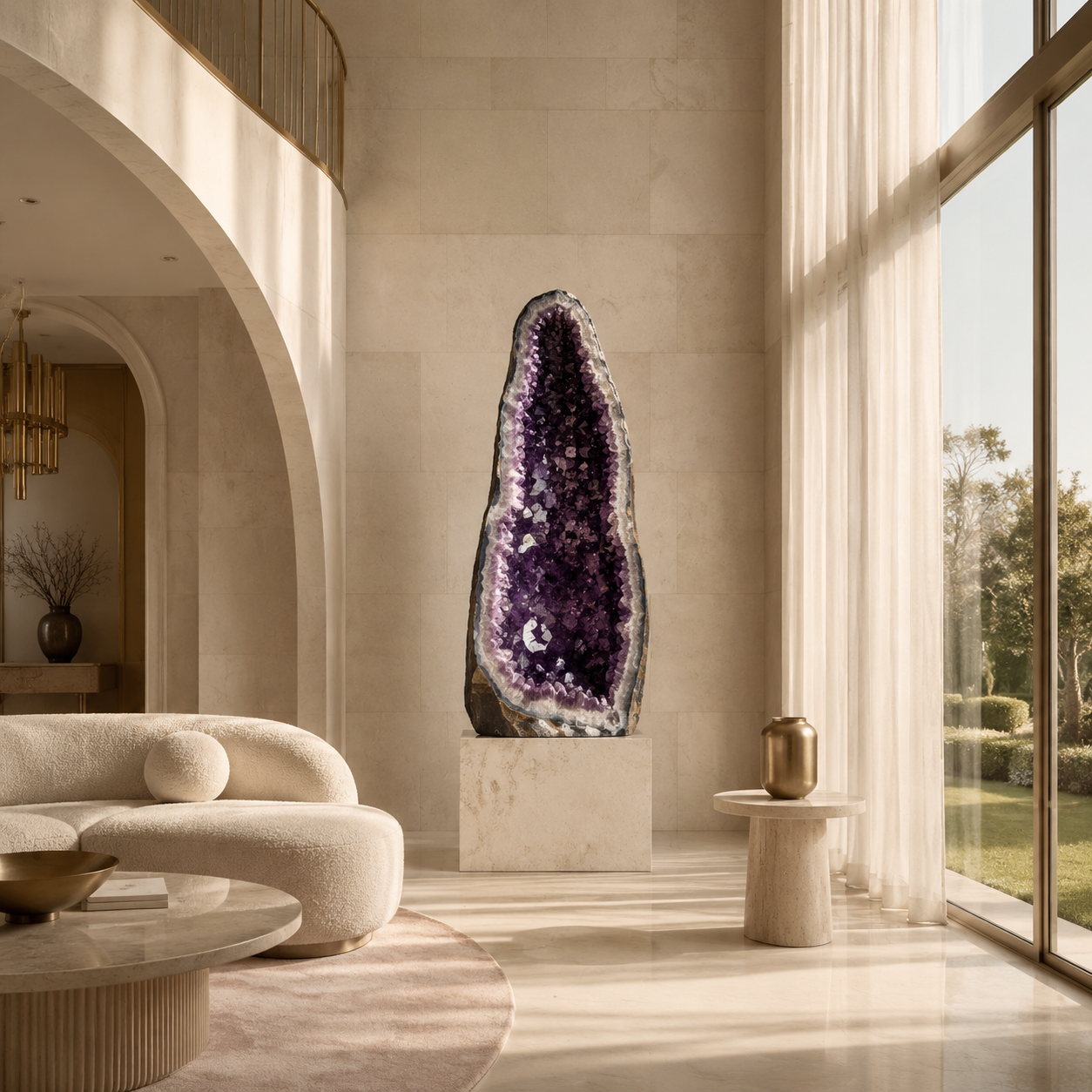
How to Style Large Crystals in a Luxury Home
Discover how to style large crystals with scale, light and intention—and transform a one-of-a-kind natural specimen into a defining work of art within your home.
Read more
The Beauty of Beginning Again: Reinventing Yourself in a New Season
There comes a moment when who we have been no longer fits who we are becoming. Explore the beauty of reinvention, the purpose within life’s changing seasons and the quiet courage it takes to begin ...
Read more